

American Mythos
Part 1 of ... maybe just 1.
Gods don’t exist. We still have to invent them.
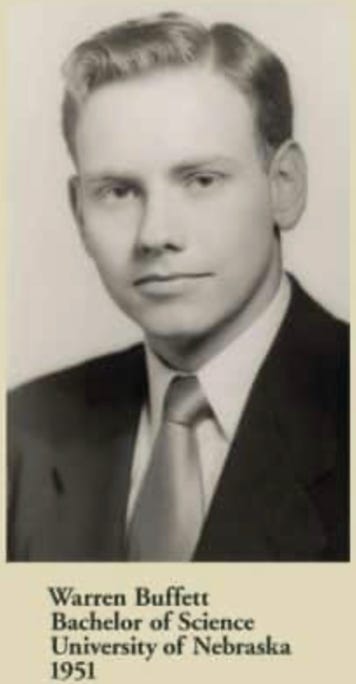
The Oracle of Omaha.
As of January 1, 1951, Warren Buffett owned in his father’s firm Buffett & Co, Selected Industries, U.S. & International Securities and Parkersburg Rig & Reel. During the preceding year he took a single loss of %1 on a position in Marshall Wells.
His marketable assets totaled $9,828.70. These figures come from Buffet himself who provided the data to Andrew Kilpatrick’s the author “Of Permanent Value.”
Using the US Bureau of Labor Statistics inflation calculator this is equivalent to $121,202.71 today. According to the Federal Reserve’s 2022 Survey of Consumer Finances, the net worth for 21 year Americans in 2022 fell between $1,671 and $11,935. With the median net worth of $4,774. So by all accounts Buffet had quite a head start.
At the time Warren was working for his father, who owned a stock brokerage firm and held a seat in the US Congress, doing sales.
His father Howard also liked to write articles in his free time on economics. Here is excerpt from an essay he wrote in 1948.
“But when you recall that one of the first moves by Lenin, Mussolini and Hitler was to outlaw individual ownership of gold, you begin to sense that there may be some connection between money, redeemable in gold, and the rare prize known as human liberty <snip> But first let me clear away a bit of underbrush. I will not take time to review the history of paper money experiments. So far as I can discover, paper money systems have always wound up with collapse and economic chaos.”
Just to be clear the US has done just fine since 1948. At least until very recently.
Warren was just 21 in 1951 having recently graduated from the University of Lincoln-Nebraska with a degree in business. He was single and did not own a home.
Not what you would consider a solid credit risk but regardless he was able to take out a loan for $5000, which represented 51% of his marketable net worth at the time, to buy stock. His first official year as an investor we was levered up 50%.
Does this sound like you? Or anyone you know? Son of a Congressman who owned a stock brokerage and who had access to borrow half their net worth at 21?
In 1951, Standard & Poor kept an index of 90 stocks, the S&P 90. The agency had first created this index in 1926 to track the market following after Charles Dow and the Dow Jones Industrial Index which tracked 30… wait for it… industrials. The S&P 500 we know today did not come into existence until 1957. The full list of what was in the index in 1952 I can not find but we can guess.
The S&P 90 was composed of 50 industrial names - just to have more than Dow, so stocks like Allied Chemical & Dye, Bethlehem Steel, and added 20 “rails”, Southern Railway, Baltimore & Ohio Railroad, and 20 utilities, Commonwealth Edison, Detroit Edison, Niagara Mohawk Power, etc. Everyone was creating indexes. NY Times index tracked 50 stocks for example.
We know with dividends the S&P 90 returned 23% and the DJI returned 21% in 1951. If running the same leverage and just buying the index an investor would have returned 34.5% in the S&P 90 and 31.5% in the DJI.
Buffet returned 75.8%. That seems impressive.
But we really don’t have anything to compare it to since individual security returns from 1951 are nearly impossible to come by. We don’t know what he could have returned.
We do know he didn’t buy Texas Instruments which was founded in 1951. Nor Burger King, McDonald’s, Visa, Mattel, Walmart, Playboy, Nike, etc because none of these companies existed yet. Co
But what do know specifically about Warren’s chose securities tells you quite a lot.
U.S. & International Securities was a leveraged trust set up by Clarence Dillon who at the time in 1951 was one of the richest men in America. What is amazing is that from 1924 to 1929, Dillon’s U. S. & Foreign Securities Corp of which USIS was pyramided on top of, returned 28,000%.
That’s right. It was a good old fashion pyramid scheme.
The degree of financial engineering Dillion and his cohorts displayed revivals that of Elon Musk’s accounts today. If you really want to make money in the stock market ignore Buffet and study Dillon because he understand the market far better than anyone else.
Buffet also owned Selected Industries, a closed end fund - ie private equity - which was a highly leveraged managed trust. So Buffet’s returns were derived using money he borrowed then invested into two highly leverage securities managed by other people. And, his position in his father’s firm which in the following year had a balance down 50%. So he either sold or it fell in value.
The only company that Buffet owned were Parkersburg Rig & Reel, an oil company, and Marshall Wells which he sold at a loss.
What is never discussed is how 1951 was a rather important year in American finance. It is the year that the Fed removed caps on bond yields that had been imposed in the 1940s. It was the beginning of the boom in American history. Prior to 1951, the DJI had been essentially flat since 1937. In July of 1951 alone, the market return 5+%. 1951 was the beginning the greatest wealth expansion in human history. 1951 was the 2010 of its era. When money printing really took off.
Buffet had every advantage. He timed the best possible market in human history solely by graduating one year before the Fed changed policies and had access to free capital and the balls to go double leveraged.
He was essentially using a credit card to buy two 2x leveraged ETFs right when the US started allowing money printing. So getting a 2x return actually under performs what you would expect running 50% leverage into a 2x leveraged ETF. There are a lot of people who were buying 3x leverage ETFs in 2018 and again in 2021. We call those people degenerates. Buffet would have fit right in with Wall Street Bets.
A 75% return in those conditions is really not that impressive. Frankly, unless he had inside information from his father about the Fed’s change in policy his investments in 1951 were quite risky. The exact opposite of value investment. Alcoa would have been a value investment after it came through the anti-trust ruling.
Now, I am not proclaiming Buffet was dumb here, though if you were 21 and took out a loan equivalent to half your assets and bought into two highly leveraged funds one of which was a pyramid scheme today, I don’t have a better word to describe you, accept maybe brave, what I am just posting this so people stop comparing themselves to Buffet.
Stop.
How Buffet has made his money is not how the book stores claim. And the conditions from which he made his money we don’t have today. Nor will anyone alive in the US have again, unless the US goes through another depression.