Fun with Data
Tuesday August 19, 2026
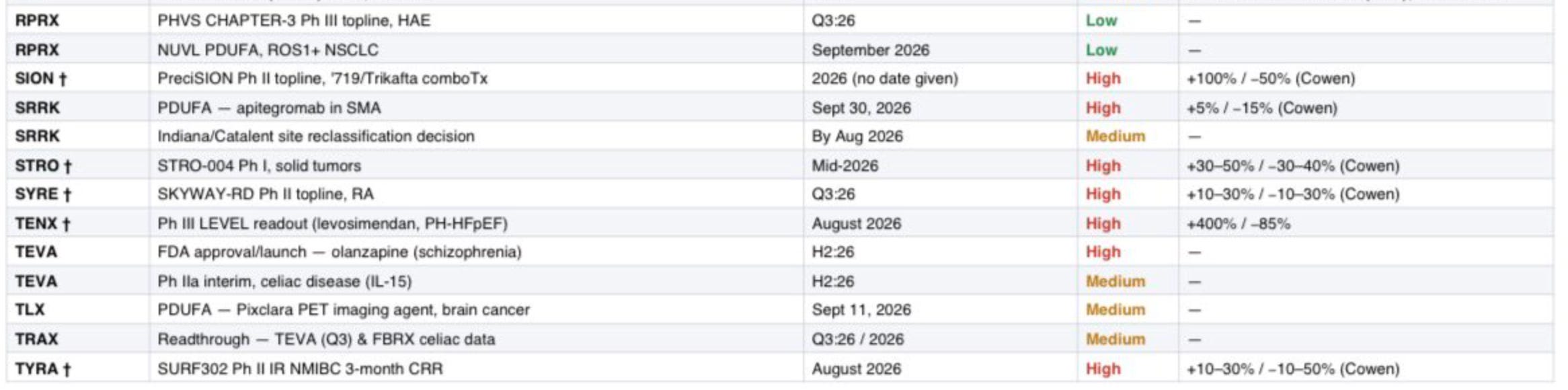
A document went around social media a few weeks ago before ($TENX) dropped its data. I saved it because I knew I was going to write this post.
I don’t know what model the investment bank that put this together used to calculate a potential +400% upside (and it’s been so long I don’t remember which bank this report came from) but I am going to assume that it is based on probability and not some intern making a guess. Assuming it is a good faith value, I am going to trust it and use it to illustrate a point. That might not be a valid assumption as this may have been a sell-side report. Wall Street is not very honest to be frank.
Let’s work backwards.
If the bank estimated the price would move +400% what odds were they placing on the trials outcome being positive? You may guess 10% or 20%.
It is safe to assume that a trial result that does not move the stock price was an expected result or at least mostly expected. So the bank showing a binary expected return of +25% means the bank would be putting a high probability on the result and vice versa. A result that is expected to move a stock a lot would not expected.
Everything below comes from our database. We have redundant systems and pretty high data fidelity but still I can’t 100% guarantee we have all data. But, feel free to reproduce this analysis yourself. Mine herein is close enough.
Here we go into the rabbit hole. Don’t worry there is no math here.
In the last 365 days, there have been 7 events that induced a +400% move in a biotech (ignoring OTC, Pink and obvious pump and dumps.)
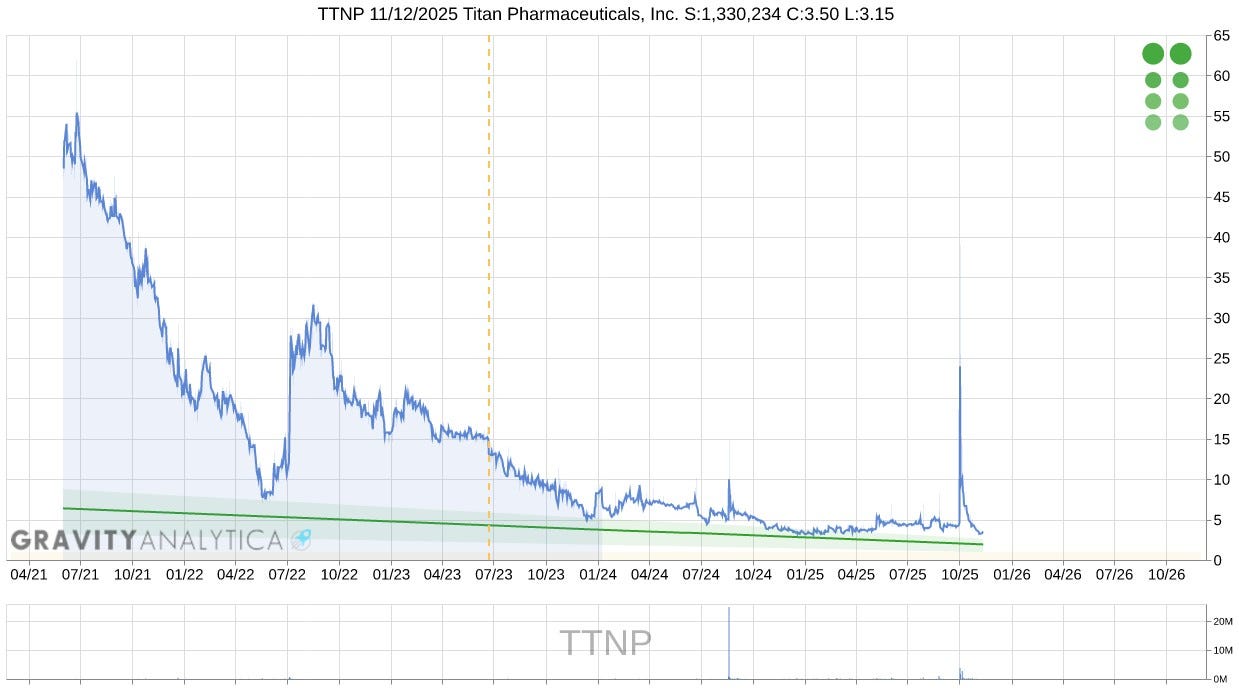
One of those moves was in a very illiquid stock. Here is a chart for that one move. Two of the companies are out of China. Read into that what you will. So four were potentially actual valid moves. Not a whole lot. That’s out of around 800 biotechs. The number of active biotechs has varied over the last year but unlike EDGAR we keep all data even if CIKs change and companies disappear. Same with press releases. We keep all of those as well.
For just biotechs, we have in our database 128k SEC-related events recorded in the last year. We do NOT record all SEC filings. Just ones material to our modeling.
The database also shows 7,829 clinical events and 2,309 conferences or presentations.
So potentially four moves of +400% out of thousands and thousands of potential events.
Not sure the last year is enough data.
In the last two years, there were 30 such moves. Seven were highly elastic i.e. were likely pump-and-dumps. But, trickier ones.
This is very important.
Because of COVID and the post-COVID financial hangover a lot of companies had trial delays. And a lot of companies that would not have been listed were forced onto the public market. These conditions created a scenario where weak biotechs just disappeared and very strong biotechs ended up public that normally would have never gone public.
Companies that under normal market conditions would have been acquired or been able to raise capital without the public sector. If you pay attention to M&A you will see private companies getting acquired in the space all the time now.
But, for a time period after 2021 this slowed and basically stopped. This means last year was anomalous.
Of those 30, eight of those moves were due to positive trial data.
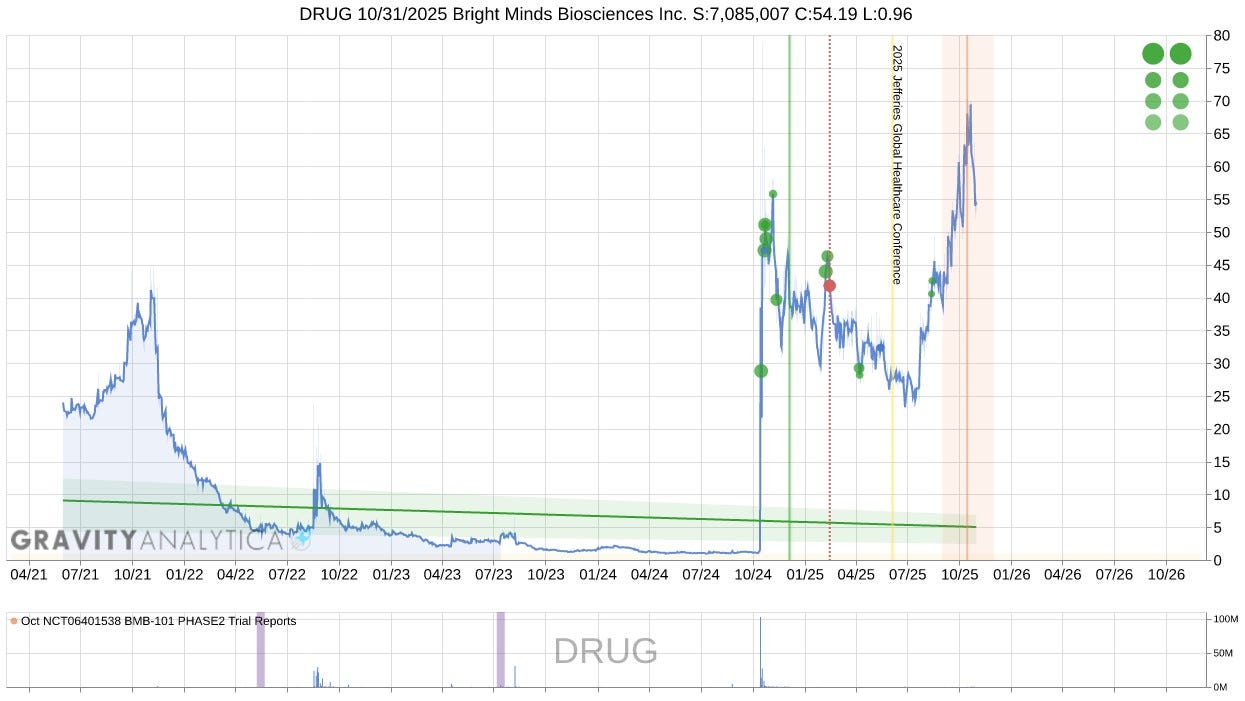
Here is the biggest one and the one we missed unfortunately. Yes, it was below the channel at the time of the move. I have no idea how I missed it.
Over the last two years, there were 16,914 clinical events and 5,718 conferences or presentations.
The chance of a clinical trial move being +400% or more is for all intents and purposes is zero. If you see a report saying +400% you need to assume the investment bank is similarly telling you the chance is zero.
That’s just the data.
Assuming there were 2000 events to keep the math simple (sorry I lied there is math,) we can calculate the probability of estimated success based on the stated predicted return to be 0.4% ± 0.14%.
It’s the error there that needed the math. That is basically zero plus a little wiggle room to still be zerO.
Think about it.
The price that stock trades at the day before data is already pricing in some chance of positive results. And it is priced based on the group of people who know at least something about the drug and a herd of people who have no idea what they are doing. But are enthusiastic.
If the drug was a lock the price would already reflect a very high odds of that happening so the potential move would be small.
So if the expected return on a positive result is extreme that means the market, i.e. no one with actual money, believes the drug will work. I want to be very clear. The fact some social media fin-fluencer thinks it works is immaterial.
If a drug was certain to work someone would buy the company before the data was dropped because it would be cheaper to do so.
The biggest moves in biotechs are NOT due to trial result data releases anyways. You’re playing the wrong game.
The moves are due to corporate actions that the market can’t predict. Like when a company acquires a new asset.
Stocks primarily move BEFORE the data is due anyways. Tenax moved 600% before data. Amylyx moved 1200% before data. The goal is to buy before everyone else even starts to think about the drug’s MOA. If you are trying to figure out if the drug works then you are already late.
Don’t confuse a hedge fund holding a stock with confirmation or belief in the drug either. Hedge funds run risk models and can and will throw darts sometimes and a hedge fund is trading other people’s money. People tend to take outsized risks when they are trading other people’s money.
Ask Danny DeVito.
It is not uncommon to find a big trillion dollar AUM fund holding a small position of a totally worthless company because some code was fulfilling a bucket of tail opportunity.
Programs do stuff like that.
— AJ
Good to know I am not a bot. I had been worried about this.