

The greatest folly.
When an AI translates cat from English to French or from English to a generated image of a cat the program is operating in a very dense (vector) space.
Visually with blue. Point your finger in this circle. You are now an LLM.
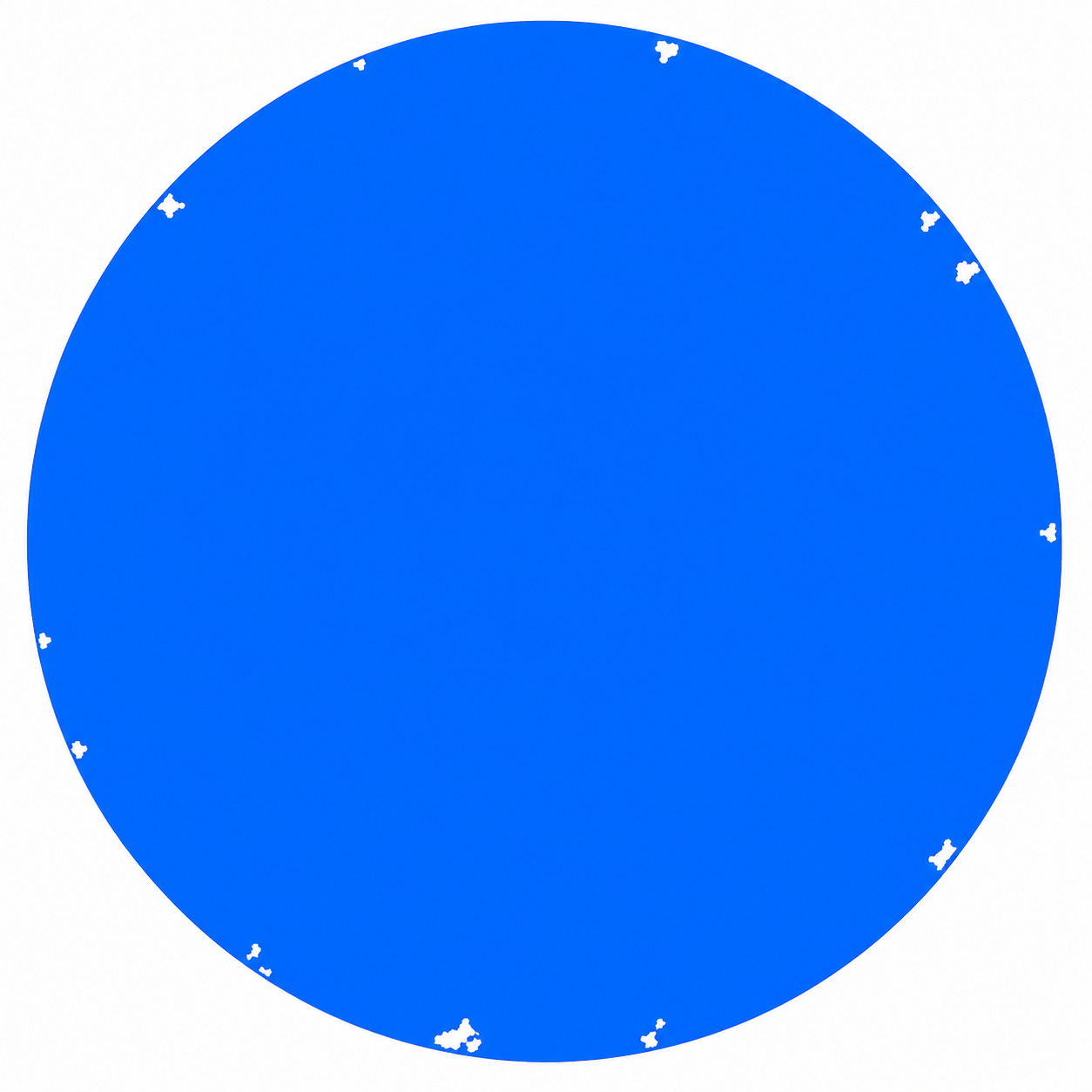
No matter where you point to in that circle the answer will likely exist. And if you happen to hit a point in (vector) space where there is no answer the locus of points nearest will be related so a guess will likely be accurate enough. Let’s say Christopher Nolan’s new movie events the phrase scratch-tastic. Most likely the meaning of that world will be online soon and you just need to refresh the browser.
This works no matter how complicated a string of words is too. The space with which the transformation is happening is very dense. There is no possibility of you asking What is the French word for X? and the correct answer is an elephant wearing a towel falls from the sky.
The reason is because humans defined English and French. Humans defined what is and is not a cat. But, outside of languages, English, French, the visual language of color, shape, texture, Python, C++, mathematics, etc. Nothing in our world is a dense (vector) space because we didn’t define the real world. To stretch the analogy here to the point a mathematician would have an aneurism that space where you are pointing with your finger isn’t flat either. There is a chance where you put leads to an elephant sitting on your head.
For example, what if you wanted to map biology to medicine. These are very close together in the card catalog.
Visually with green.
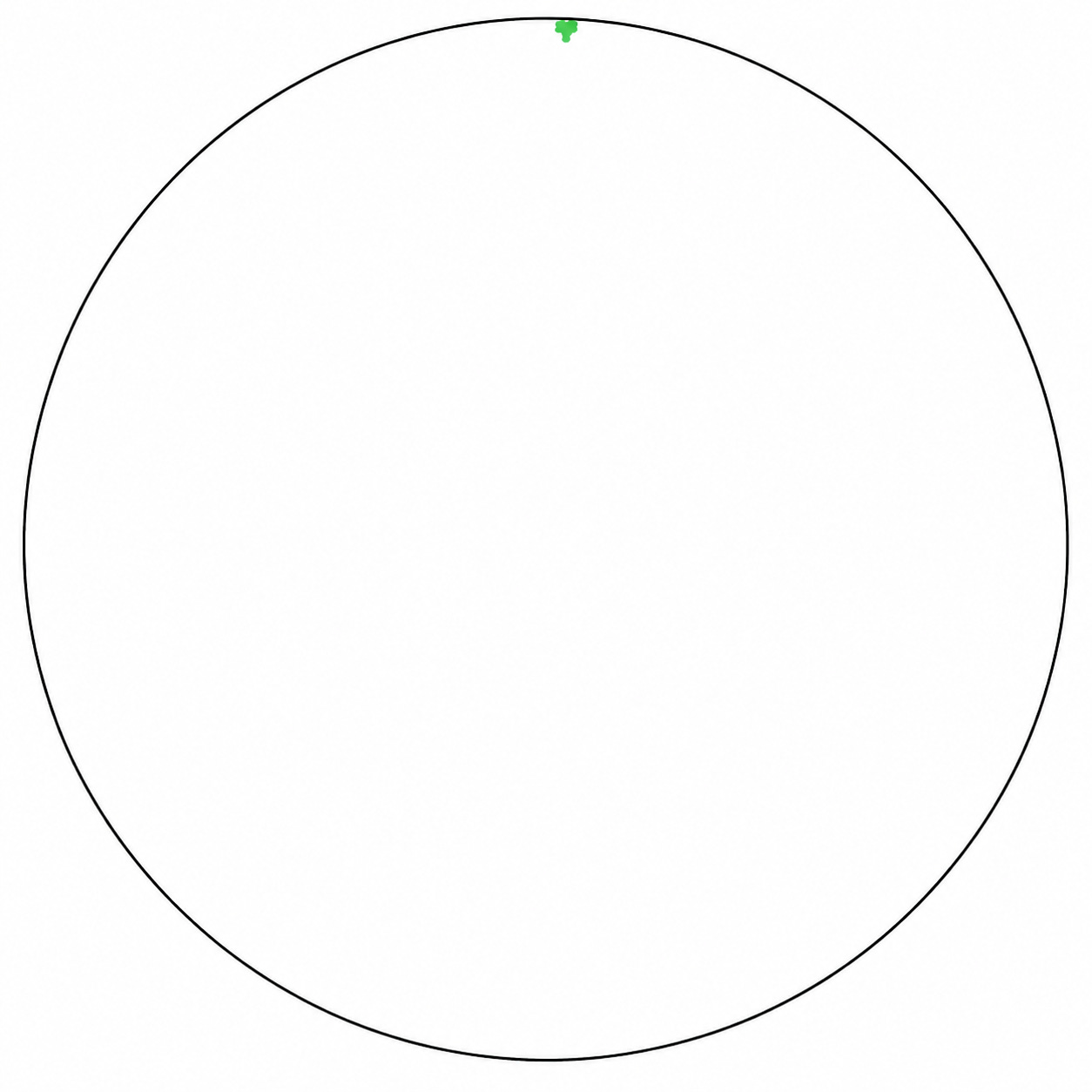
Now, this may appear hyperbolic. But, it isn’t. Humans know very, very little about the biology and how if affects our health and most of what we know is superficial. If you plug Shakespeare’s entire works in English into a program you can get back the French version but if you plug a DNA molecule into a program you can’t get out prostate cancer at 45.
And, even if you could how would you predict mutations that might occur in that person carrying that DNA’s cells?
Not only is the (vector) space sparse but it is infinitely more complicated - ie it isn’t flat. There is a parachuting elephant probability.
If you were to ask a question and point to a space where we do have the nearest neighbors defined in one dimension we don’t know how wrong we would be in any other dimension. So not only will the answer likely be wrong. It will likely be dangerously wrong. Time consumingly wrong. No one said chocolate is good. Peanut butter is good. We should mix these. Someone had to accidentally walk in front of a microwave ray with a candy bar to figure this out.
For example in medicine, does gut biome change that age from 45 to 55? We don’t have a clue. That is a question in the blank space of human knowledge. The fact is the blank space i.e. the stuff we don’t know is vastly underestimated by the people selling AI to the masses.
Humans didn’t define chemistry, physics, biology, etc. And we can’t explain any of it outside of weak probabilistic representations or in a very limited capacity based on generalization.
If you want to understand just how far we have to generalize picture the trajectory of a cow. In order to figure out where the cow will fly off to physicists consider the cow to be a point.
This works for ballistics of a cow. But, give the cow, a cow sized kite with some flexible textile and we have no idea where it’s going to go. We can model it. We can animate it. And it will look accurate but until we can never be sure where Bessy is really going to end up.
This current AI concept doesn’t work for cancer. Or weather. Or climate change. Or flying cows. In fact, it is replacing systems and programs that are much more accurate.
Even the next generation concepts which are going to try and constrain AI with actual physical modeling aren’t going to get much farther for thermodynamic reasons. That means there isn’t enough energy to handle the calculations necessary to do the most basic things.
Taking all whole corpus of human knowledge and putting it somewhere is great. We did that. It’s called the internet. Giving the internet a cocky, over confident librarian that removes all need for the questioner to search and find the answer is fucking dumb.
Removing the ability for the librarian to say “I don’t know" meaning humans don’t know is a calamity.
OpenAI, Anthropic and the like are all run by people who are used to the synthetic digital world. To them everything, to quote Elon Musk, is “really easy.” And, nothing is really easy in the real world. I doubt anyone of them have ever say down on the grass and tried to find a four leave clover. Which is something every really needs to do once in their life just to understand how different ever three leaf clover leave really is.
We are wasting resources and we are destroying humanities ability to think at the same time. So we are lighting the Earth of fire and hastening Idiocracy at the same time.
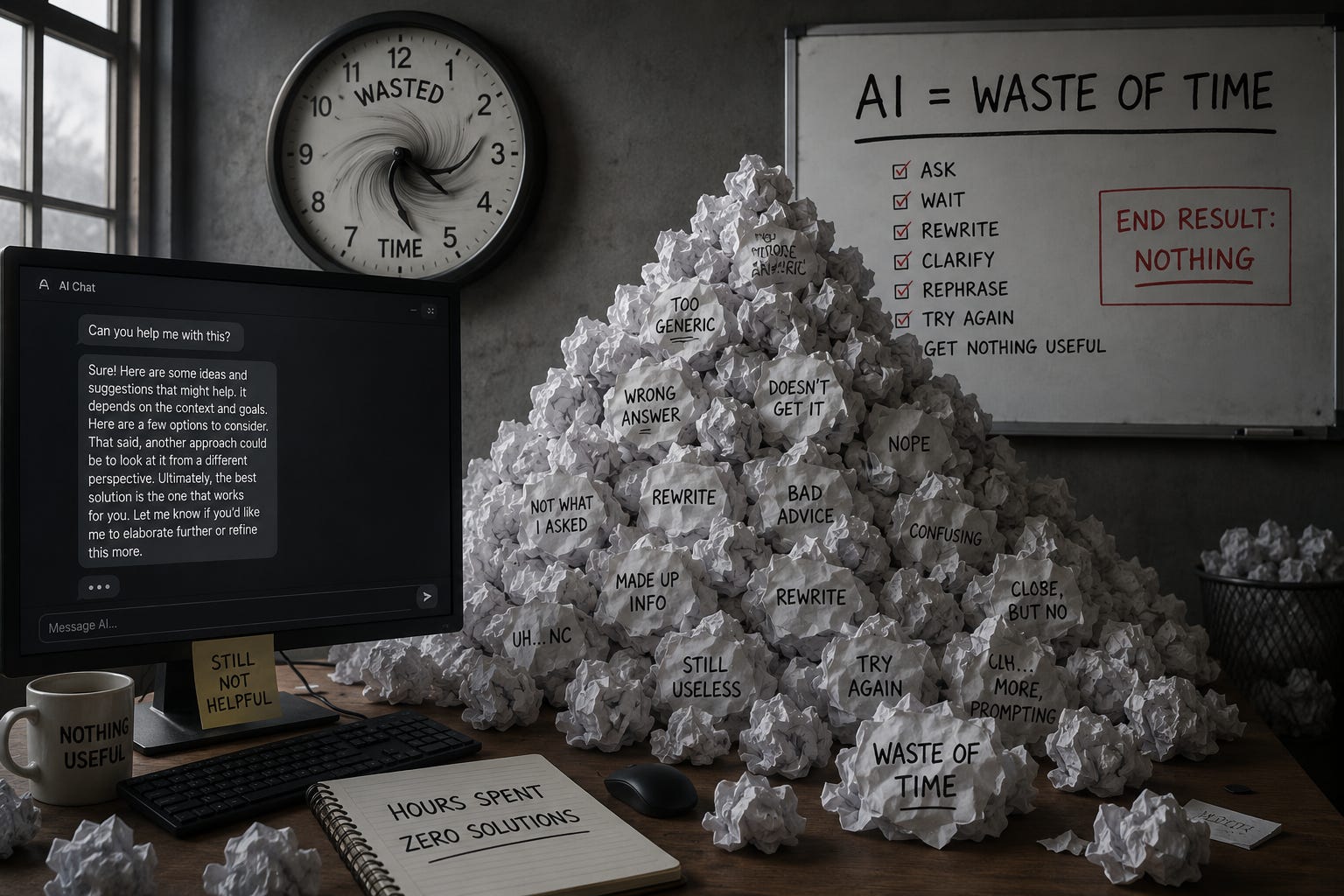
This AI push is the greatest folly in human history. It appeals to only people who see dollar signs. But, it did make me a nice trash pile desk image.
So there’s that.
If you do the math on what the average temperature on Earth will be after humans burn all the known fossil fuel reserves it’s pretty terrifying.
The Earth will be around 10°C-15°C warmer. If you don’t believe me ask ChatGPT. I am sure it can do the math.
That means the average temperature on Earth will go from 15°C to 25°C (59°F to 77°F.) This means most of the land on Earth will exceed the wet bulb temperature during the day.
So going outside for any extended period of time will be fatal. You will drown as the coolest surface, the surface where humidity will condense, will be inside your lungs.
It means the time of mammals will end. Agriculture will end. And dipshits today are installing jet turbine engines to power data centers.
This is all 250-400 years into the future though.
I don’t think AI is a bubble. I think humanity is a bubble and AI popped it.
-AJ