

What Happened Today?
Saturday March 28, 2026
Part of what I do is fieldwork. Some of it is fun. Most of it is voyeurism.
Today, before the Braves Game I went to a card show. If you want to know how the economy is doing the best way is to watch people waste gobs of money.
I first attended a sports card show in 1988 before the hobby imploded from the Upper Deck reprint scandal, the Brett Lemieux scandal and Operation Bullpen. Before the industry realized 40 year old men have way more money than 8 year old boys and started to produce cards solely for speculation.
Back then packs of cards were 25 cents. Mickey Mantle charged $50 for an autograph and would actually talk to you - kind of. Compare this to Clint Eastwood who just did a private signing for $1500 a piece. You didn’t even get to hand him the item. You mailed it off.
Right before I bought my first baseball card the coin market had just imploded in what Numismatists called the Slab Bubble. This is pretty obscure history unless you happened to study markets.
In 1986, PCGS was founded to compete with ANACS (think PSA and Beckett but for coins.) PCGS had the great idea to create an “index” to track the rare coin market it was the first disruptor really.
They selected 3000 of the most desirable collectible coins and tracked the prices from the moment the first coin was graded in 1972 forward. From 1986, when the index prices just started to go up parabolically. PCSA made slabbing more accessible and they opened the hobby suddenly common cards gained prestige without the fuddy duddy ANACS process.
The prices were going up so fast, there was a time when dealers wouldn’t sell coins because they would be worth 5 or 10% more in a few weeks and getting more inventory was difficult. The back up to get coins graded slowed turnover.
While walking around the card show today I was counting the high end cards that were for sale. LeBron James, Shohei Ohtani, Wayne Gretsky, etc. And there weren’t any. Dealers are actually sitting on cards expecting the value to go up.
Everyone at the show was buying but the high end cards were not for sale. Everyone was walking around with their app checking “comps” (comparable recent sales) and dealers were paying 90% if anyone happened to have anything for sale. Collectors were checking apps for what they should pay as well.
90% of what the card sold for last week or in some cases yesterday. When you consider the margins of running a store or traveling to a card show 10% margins doesn’t make sense.
Unless you expect the card to go up 10% next week.
I watched a buyer count out $30k in cash for a Michael Jordan PSA 9 card 1986 Fleer Rookie Card. A card that is by definition a common card. There are 5000 graded Michael Jordan Rookie Cards and there is always one at this grade for sale or auction somewhere.
But, nothing “rare” was even on offer. The one Messi rookie card I found wasn’t for sale. Now I know why this is. The truly high end cards are getting ridiculous premiums at auction right now. Cards are doubling or in some cases 10x estimates right now.
This is partly because big money (read private equity) is manipulating the market but mostly because collectors and dealers are parking. This very much has a slab bubble feel to it. The investors driving up the top end are dragging up much more common cards and dragging everyone with them. But, the top end prices are synthetic. Just like the NFT craze. The headline figures are not actually valid sales. It’s promotion for the auction houses.
What I did find was a lot of fishing.
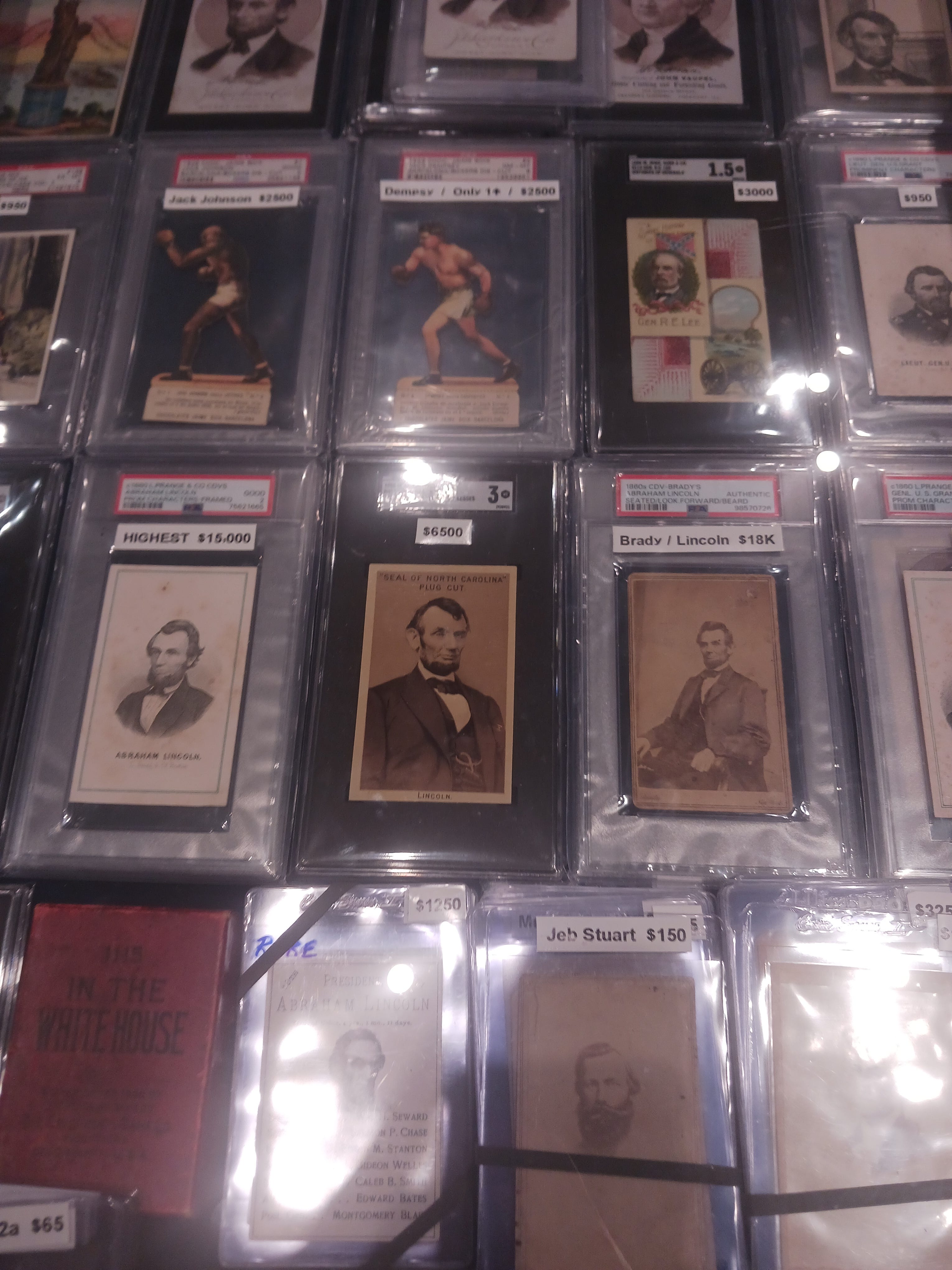
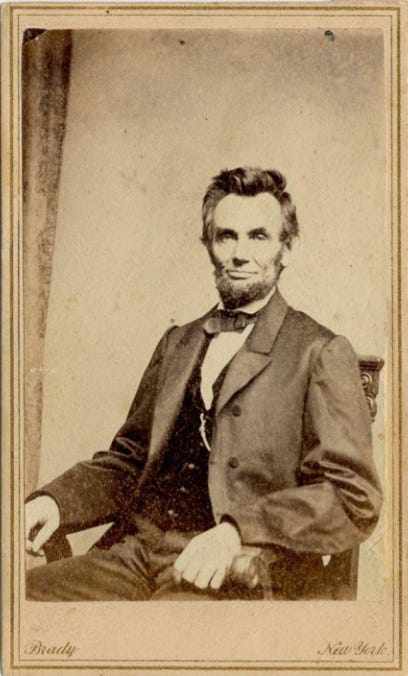
Below are three Abe Lincoln “cards.” The one on the right listed for $18k ($25k on Ebay) and is reported by PSA as population 1. But, I personally know this carte de visite (CDV, i.e. photograph) is not rare. I found one a few years ago at an estate sale for $1 here in Atlanta.
Here is another one in much better condition that sold for $2400 in 2023 at auction. Does putting a card in a PSA holder increase the value 10x? Does encapsulation matter for something like this?
There is this very weird economic dynamic right now. People can’t afford to buy a new home, can’t afford to upgrade their homes and are carrying low interest loans or have paid off their mortgages and are just spending what extra money they have.
There is an entire segment of the population today that has put their retirement plan into plastic wrapped cardboard.
But, the US is also in a mini baby boom so at some point people are going to have upgrade their houses.
Those selling cards are hoarding what they think will continue to go up. Anything that is 1 of 50 or 1 of 25, manufactured scarcity, is sitting in someone’s safe somewhere. The issue is there are dozens of 1 of x cards produced every year for the last twenty years. When everything is scarce/rare nothing is.
If I were to create a baseball card index (or maybe a general sports card index) what would I put in it? Actual rare cards like the E90 American Caramel Joe Jackson card? Maybe a card from the Ferguson Bakery set?
Or more attainable cards like 1951 Mickey Mantle that just command a premium?
Well I don’t have to think because CardLadder has already done this. When you look at that list and see the top card’ one month change is up 50% it’s obvious there is bubble here. But, someone paid that.
So there isn’t a recession, yet.
I can’t see the future but as oil stays elevated and the US pushes into stagflation I fear this isn’t going to end well. So watch that index. Most likely when it rolls over the economy will already be in the dumps but maybe it’ll start to shake first.
When the coin slab bubble crashed in April 1989, the index fell 75% and never really recovered. The Black Monday stock market crash of 1987 was partially to blame. That crash shook the trees and though it took awhile eventually coin prices couldn’t be supported and all the people speculating had to liquidate and down the market went.
In the last 30 years it’s barely moved.
-AJ